All Guides
Why Are There Swastikas at Korean Temples? The Buddhist Symbol Explained
The swastika-like symbol (卍) at Korean temples is not what you think. Learn the 5,000-year history of the Buddhist manji, how it differs from the Nazi symbol, and where you'll see it across Korea.
swastika korean templewhy are there swastikas in koreanazi symbol korea templeswastika buddhist temple meaningkorea temple nazi sign
Don't Panic — It's Not What You Think
You're exploring a gorgeous Korean temple, admiring the hand-painted wooden beams, the ancient stone pagodas, the smell of incense — and then you see it. A swastika. On the roof. On the Buddha statue. On the map you used to find this temple.
Take a breath. What you're looking at is the manji (만자, 卍), a sacred Buddhist symbol that has been used across Asia for thousands of years. It has absolutely no connection to Nazi Germany. In fact, its meaning is the polar opposite: peace, harmony, good fortune, and the eternal turning of the dharma wheel.
This guide explains what the symbol is, why it's everywhere at Korean temples, how it's different from the Nazi Hakenkreuz, and the surprisingly deep history behind it.
What Is the Manji (만자)?
The manji is a cross-shaped symbol with four arms of equal length, each bent at a right angle. In Korean, it's called manja (만자), which literally translates to "the character for ten thousand" — where man (만) represents myriad, infinity, or the totality of existence.
In Sanskrit, the original word is svastika, from su (good, well) + asti (it is) + the diminutive suffix -ka. It literally means "it is good" or "all is well."
The symbol appears in two mirrored forms:
• 卍 (left-facing, counterclockwise) — the form predominantly used in Korean and East Asian Buddhism • 卐 (right-facing, clockwise) — also used in some Buddhist traditions, and the form appropriated by the Nazis
In Korean Buddhism, the left-facing 卍 is standard. You'll see it sitting flat on its base — stable, grounded, and balanced.
A Symbol Older Than Recorded History
The manji is not a Buddhist invention. Its history stretches back far beyond any single religion or culture.
• ~15,000 years ago — The earliest known example is a pattern carved onto a mammoth-ivory bird figurine found near Kyiv, Ukraine, dating to the late Palaeolithic era.
• ~6,000 BCE — The Vinca culture in present-day Serbia, Croatia, and Bosnia used the symbol on pottery and ritual objects.
• ~3,300–1,300 BCE — Swastika motifs appear on terracotta seals, pottery, and ornaments throughout the Indus Valley Civilization at sites including Harappa and Mohenjo-Daro.
• Ancient Mesopotamia & Troy — The symbol appears on Mesopotamian coins and artifacts, and prolifically at the archaeological site of ancient Troy.
• ~500 BCE onward — Buddhism adopted the svastika as one of the 32 auspicious marks (lakshana) on the body of the Buddha. As Buddhism spread from India through Central Asia, China, Korea, and Japan, the symbol traveled with it.
• 907–1125 CE — During the Liao Dynasty, the paired characters 卐 and 卍 entered the Chinese writing system as variant characters for "myriad" (wan/만).
The symbol has been found across every inhabited continent — in Greek, Roman, Egyptian, Persian, Celtic, Norse, Native American, Hindu, Jain, and Buddhist art. It is one of the most widely used symbols in human history.
What It Means in Korean Buddhism
In Buddhist tradition, the manji carries layered meanings:
• One of the 32 Marks of the Buddha — The manji is considered one of the physical characteristics (lakshana) that adorn the body of an enlightened being. It specifically appears on the Buddha's chest, and is also depicted on his palms and feet. In Sanskrit, this mark is called Srivatsa.
• The Dharma Wheel — The symbol represents the turning of the Buddhist teachings (dharma), the continuous cycle of teaching and practice that sustains the faith.
• Samsara — The four arms symbolize the eternal cycle of birth, life, death, and rebirth — a core concept in Buddhist philosophy.
• Universal Harmony — More broadly, the manji represents the interconnectedness of all things, the balance of opposing forces, and the wholeness of creation.
• Good Fortune — At its most basic level, the manji is simply a sign of auspiciousness. Buddhist texts often begin with this symbol.
When you see 卍 at a Korean temple, you're looking at a symbol that says: "This is a sacred Buddhist space. Dharma is present here."
The Manji in Korean Temple Architecture
Source: Vishnu Murali
Where Exactly You'll See It
The manji is not hidden away at Korean temples — it's everywhere. Here's where to look:
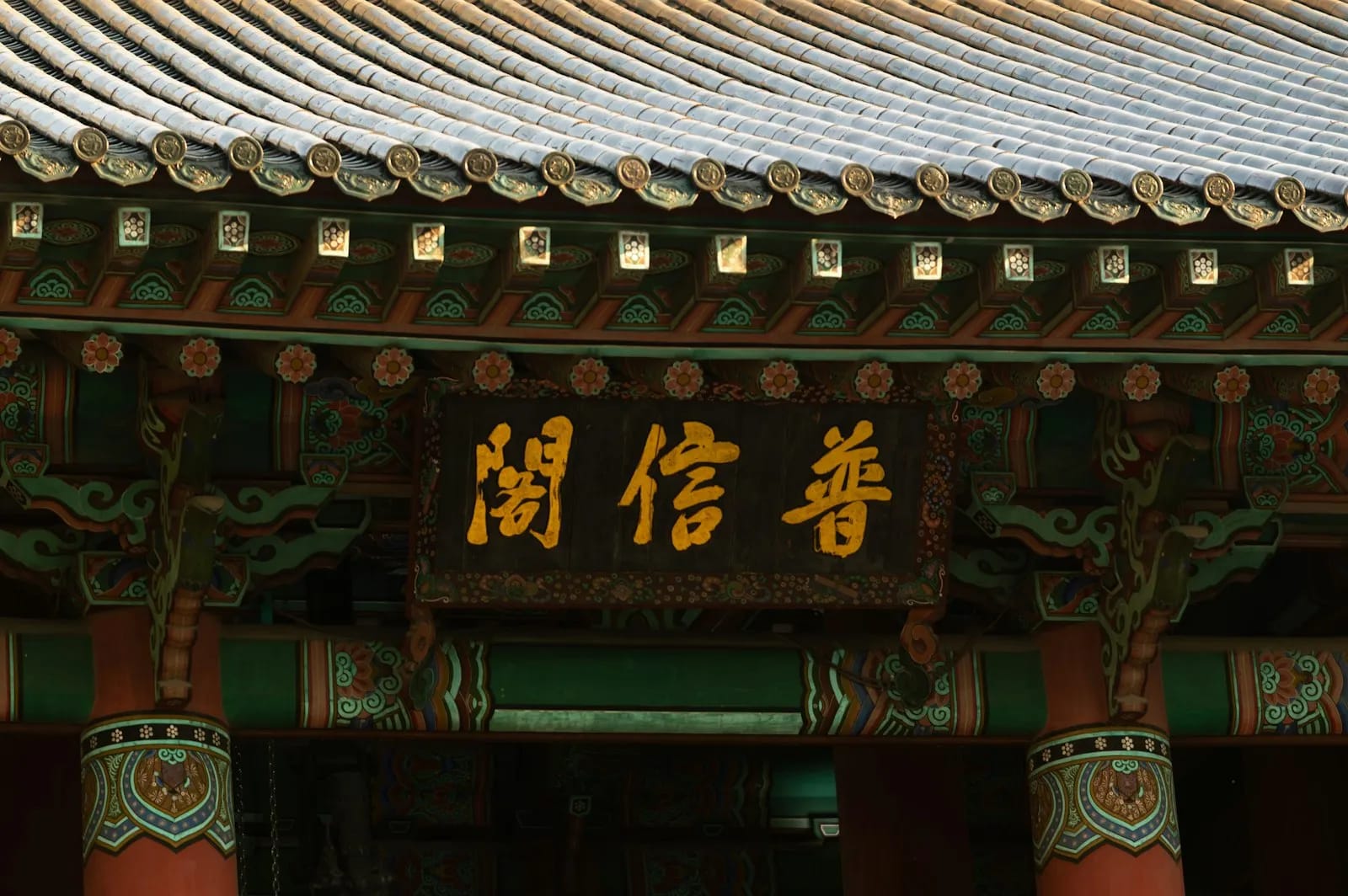
• Roof ornamentation — The ridge tiles and eaves of main halls (Daeung-jeon, 대웅전) often feature the symbol carved or molded into ceramic decorations.
• Dancheong ceiling patterns — The intricate hand-painted patterns on temple ceilings, crossbeams, and bracket sets (공포) incorporate the manji into geometric designs. These patterns are painted in the traditional five Korean colors (obangsaek, 오방색).
• Buddha statues and paintings — The manji commonly appears on the chest of Buddha figures. At Manbul Temple (만불사) in Yeongcheon, it's visible on the feet of the reclining bronze Buddha.
• Temple gates — The ceiling of the Cheonwangmun (천왕문, Four Heavenly Kings Gate) at many temples features rows of manji patterns.
• Stone lanterns and pagodas — Carved into the stone surfaces of lanterns (석등) and pagodas (탑) throughout temple grounds.
• Paper lanterns — The lotus lanterns hung during Buddha's Birthday celebrations sometimes include the symbol.
• Korean maps — This is the one that surprises most visitors. On every Korean map — including Naver Map and Kakao Map — the 卍 symbol is the standard icon marking the location of a Buddhist temple. It functions the same way a cross (✝) marks churches on Western maps.
The Manji (卍) vs. The Nazi Hakenkreuz (卐)
Do
- The Buddhist manji (卍) faces LEFT — its arms point counterclockwise. It sits flat on its base, stable and grounded
- The Nazi Hakenkreuz (卐) faces RIGHT — its arms point clockwise. It is rotated 45 degrees to sit on a point, giving it a sharp, aggressive look
- The Buddhist manji has been used in Asian religious art for over 2,000 years. The Hakenkreuz was adopted by the Nazi Party in 1920 — a difference of over two millennia
- The word Hakenkreuz means "hooked cross" in German. It was the Nazis' own term. Calling the Buddhist symbol a "Nazi swastika" is historically inaccurate
- Many scholars and religious leaders argue that the Buddhist/Hindu svastika should not even be called by the same name as the Nazi symbol, since their meanings and histories are entirely separate
Don't
- Don't assume the symbol at a Korean temple has any connection to Nazism — it predates the Nazi movement by thousands of years
- Don't ask monks or temple staff to explain the symbol in relation to the Holocaust — this would be like asking a church to explain the cross in relation to the Crusades
- Don't photograph the manji out of context and post it on social media without explanation — this contributes to the exact misunderstanding this guide aims to prevent
- Don't conflate East Asian religious heritage with European political history — they developed independently across different continents and millennia
The Global Effort to Reclaim the Symbol
In 2016, ahead of the 2020 Tokyo Olympics, Japan's Geospatial Information Authority proposed replacing the 卍 symbol with a pagoda icon on English-language tourist maps. The backlash was swift — a Change.org petition gathered thousands of signatures, and Buddhist organizations argued that removing the symbol would erase thousands of years of religious heritage. When the GSI released its updated map symbols, the manji was the one symbol that was kept unchanged.
In the U.S., Hindu, Buddhist, and Jain organizations have been actively campaigning to educate the public about the symbol's sacred origins. When New York State proposed legislation in 2021 that would teach the swastika solely as a Nazi hate symbol in schools, over 40,000 people signed a petition demanding the bill acknowledge the symbol's religious significance across Asian faiths.
In Korea, there has been no debate about altering the symbol. It remains on all maps, temple architecture, and religious art — understood as a Buddhist symbol, full stop.
A Note on the Word "Swastika"
The English word "swastika" comes from the Sanskrit svastika (स्वस्तिक), which simply means "well-being" or "good existence." The word itself is neutral — even positive.
However, because the word has become so strongly associated with the Nazi regime in Western languages, many Buddhist and Hindu organizations prefer to use the original language terms:
• Korean: manja (만자) • Japanese: manji (まんじ) • Chinese: wàn (卍) • Sanskrit: svastika (स्वस्तिक) • Hindi: swastik (स्वस्तिक)
Using these terms helps separate the sacred symbol from its political misappropriation. When you're in Korea, calling it manja rather than "swastika" shows cultural awareness.
What to Do When You See It
Nothing special. Just understand what it is. The manji is as normal at a Korean temple as a cross is at a European church. Korean people do not associate it with Nazism, and there is no controversy about its presence. If you're with Korean friends or guides and point it out with alarm, they may be confused by your reaction — because to them, it's simply a Buddhist symbol that has always been there. If you want to learn more during your visit, ask a temple guide about the meaning of dancheong patterns or the marks on Buddha statues. You'll get a fascinating lesson in Korean Buddhist art history.
Plan Your Visit
Seoul monthly averages to help you pack right
Jan-1°-8°18mm
Feb2°-6°25mm
Mar9°0°40mm
Apr17°6°65mm
May23°12°90mm
Jun27°18°130mm
Jul29°22°370mm
Aug30°22°290mm
Sep26°16°140mm
Oct19°8°45mm
Nov10°1°50mm
Dec2°-5°20mm
More Guides
Korean Buddhist Temples: Visitor Guide, Etiquette & Templestay
Everything you need to know before visiting Korean Buddhist temples — top temples to visit, proper etiquette, the 卍 symbol explained, and how to book a templestay experience.
Korean Greetings & Etiquette: What You Actually Need to Know
Skip the outdated travel blog advice. Here's how Koreans actually greet each other, why you don't need to press your palms together, and the etiquette that actually matters.