All Guides
Seoul Metro Guide: How to Ride the Subway in Seoul
Everything you need to know about Seoul's subway system — buying tickets, using T-money cards, reading maps, and navigating transfers. The easiest way to get around Seoul.
seoul subwayseoul metrokorea subway guidehow to ride subway seoult-money card
Why the Seoul Metro is Your Best Friend
Seoul's subway system is one of the best in the world — clean, affordable, on time, and surprisingly easy to navigate as a foreigner. With 23 lines covering over 1,000 stations across the Seoul Metropolitan Area, it reaches virtually every major attraction, shopping district, and neighborhood.
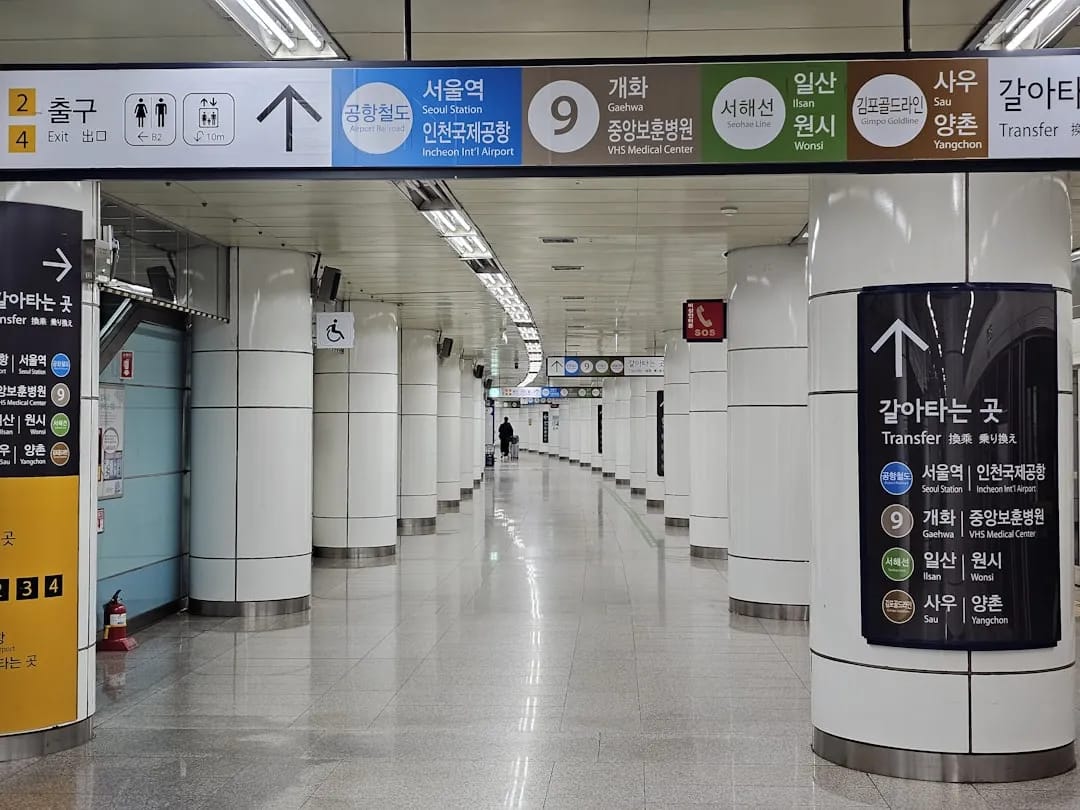
All stations have signage in Korean, English, Chinese, and Japanese. Announcements are bilingual (Korean + English). You can get almost anywhere in central Seoul for under 2,000 KRW — making the metro the fastest and cheapest way to explore the city.
Official Subway Route Maps
Click to view full-size. Swipe or use arrows to switch between cities.
Source: Seoul Metro / Korail
Quick Facts
Operating hours
5:30 AM - midnight (last trains vary by line)
Base fare
1,550 KRW (T-money) / 1,650 KRW (single ticket) — as of Jun 2025
Languages
Korean, English, Chinese, Japanese
Wi-Fi
Free in all stations and trains
Payment
T-money, credit card, single-use ticket
Frequency
Every 2-5 min (peak) / 5-10 min (off-peak)
How to Ride the Seoul Metro
1
Get a T-money Card
Buy a T-money card at any convenience store (CU, GS25, 7-Eleven) near the airport or subway station for 3,000 KRW (character designs 4,000–5,000 KRW). Charge it at the top-up machines inside stations — they have English menus. T-money works on all subways, buses, and even some taxis. You can also use a mobile T-money via Samsung Pay or Apple Pay (Korea-issued cards only).
2
Find Your Route
Use Naver Map or KakaoMap (Google Maps is limited in Korea). Type your destination and the app shows exact subway routes, transfer stations, exit numbers, and real-time arrival info. Subway lines are color-coded: Line 1 (dark blue), Line 2 (green circle line), Line 3 (orange), Line 4 (sky blue), and so on.
3
Tap In at the Gate
Hold your T-money card to the reader at the turnstile until you hear the beep. The screen shows your remaining balance. If using a single-use ticket, insert it into the slot. The gates clearly show arrows for entry and exit — follow the flow.
4
Follow the Signs to Your Platform
Look for your line number and direction signs. Platforms show the next station name and the terminal station (final destination) so you know you're heading the right way. LED displays above the platform show arrival times.
5
Transfer Between Lines
At transfer stations, follow the color-coded signs for your connecting line. Transfers are free within the system — just walk through the connecting corridors without tapping out. Some transfer walks are long (Dongdaemun History & Culture Park is notorious) so allow a few extra minutes.
6
Tap Out at Your Destination
Tap your T-money card at the exit gate. The fare is calculated by distance. Check which exit number you need — major stations have 10+ exits and the wrong one can put you 500m away from your destination.
Fare Structure
| Base fare (up to 10 km) | 1,550 KRW (T-money) / 1,650 KRW (single ticket) |
| Additional fare (10-50 km) | +100 KRW per 5 km |
| Additional fare (50+ km) | +100 KRW per 8 km |
| T-money card (purchase) | 3,000 KRW (non-refundable) |
| Single-use ticket deposit | 500 KRW (refundable at deposit machines) |
| Airport Railroad (AREX) — Incheon to Seoul Station | 9,500 KRW (express) / 4,750 KRW (all-stop) |
Key Lines for Tourists
Line 1 (Dark Blue) — Seoul Station, Jongno, Dongdaemun, Suwon. The oldest line, connects to KTX at Seoul Station.
Line 2 (Green) — The circular line looping through Gangnam, Hongdae, Sinchon, Euljiro, Jamsil (Lotte World). Covers most tourist areas.
Line 3 (Orange) — Gyeongbokgung Palace, Anguk (Bukchon Hanok Village), Apgujeong, COEX via express bus terminal.
Line 4 (Sky Blue) — Myeongdong, Seoul Station, Dongdaemun, Hyehwa (Daehangno theater district).
Line 5 (Purple) — Gwanghwamun, Yeouido (Han River parks), Olympic Park, Gimpo Airport.
Line 6 (Brown) — Itaewon, Hangang River views, World Cup Stadium.
Shinbundang Line (Red) — Express line from Gangnam to Pangyo tech hub. Driverless trains.
Airport Railroad (AREX) — Incheon Airport to Seoul Station. Express takes 43 minutes, all-stop takes about 66 minutes on the same T-money card.
Subway Etiquette & Tips
Do
- Stand on the right side of escalators — left side is for walking
- Let passengers exit before boarding
- Use the women-only cars (pink signs) if available during rush hours
- Download Naver Map before your trip — it works offline for subway routes
- Charge your T-money card with extra — you'll use it for buses and convenience stores too
- Check exit numbers before leaving the platform — saves a lot of walking
Don't
- Don't eat or drink on the train — it's considered rude and technically prohibited
- Don't sit in priority seats (marked in a different color) unless you are elderly, pregnant, or disabled — locals take this very seriously
- Don't talk loudly or take phone calls on the train
- Don't block the doors — move to the center of the car
Last Train Warning
Last trains depart around 11:30 PM - midnight depending on the line and direction. If you miss the last train, your options are night buses (called N-buses, e.g., N26), Kakao T taxi, or waiting at a 24-hour cafe until the first train at 5:30 AM. Check the Kakao T taxi guide for backup.
Useful Apps & Resources
Naver Map — The best navigation app for Korea. Shows real-time subway arrivals, optimal transfers, and exit number directions. Available in English.
KakaoMap — Alternative to Naver Map with similar subway features. Some travelers prefer its interface.
Subway Korea — Dedicated subway app with offline maps and route planning. Handy when you don't have data.
Visit Korea (visitkorea.or.kr) — Official Korea Tourism Organization site with downloadable metro maps and tourist passes info.
Korea Tour Card — A special T-money card for tourists with discounts at attractions, duty-free shops, and restaurants.
Plan Your Visit
Seoul monthly averages to help you pack right
Jan-1°-8°18mm
Feb2°-6°25mm
Mar9°0°40mm
Apr17°6°65mm
May23°12°90mm
Jun27°18°130mm
Jul29°22°370mm
Aug30°22°290mm
Sep26°16°140mm
Oct19°8°45mm
Nov10°1°50mm
Dec2°-5°20mm
Related Routes

More Guides
How to Use Kakao T (Taxi App) in Korea — 2026 Guide
Complete 2026 guide to Kakao T, Korea's #1 taxi app with 38 million users. Set up, choose the right ride type, fix foreign card rejections, avoid driver cancellations, and pay safely as an international visitor.
Taking a Taxi in Korea: Complete Guide
Korean taxis are cheap, safe, and everywhere. Here's how to hail one, use Kakao T, understand the types, and avoid common mistakes.
Korean Greetings & Etiquette: What You Actually Need to Know
Skip the outdated travel blog advice. Here's how Koreans actually greet each other, why you don't need to press your palms together, and the etiquette that actually matters.